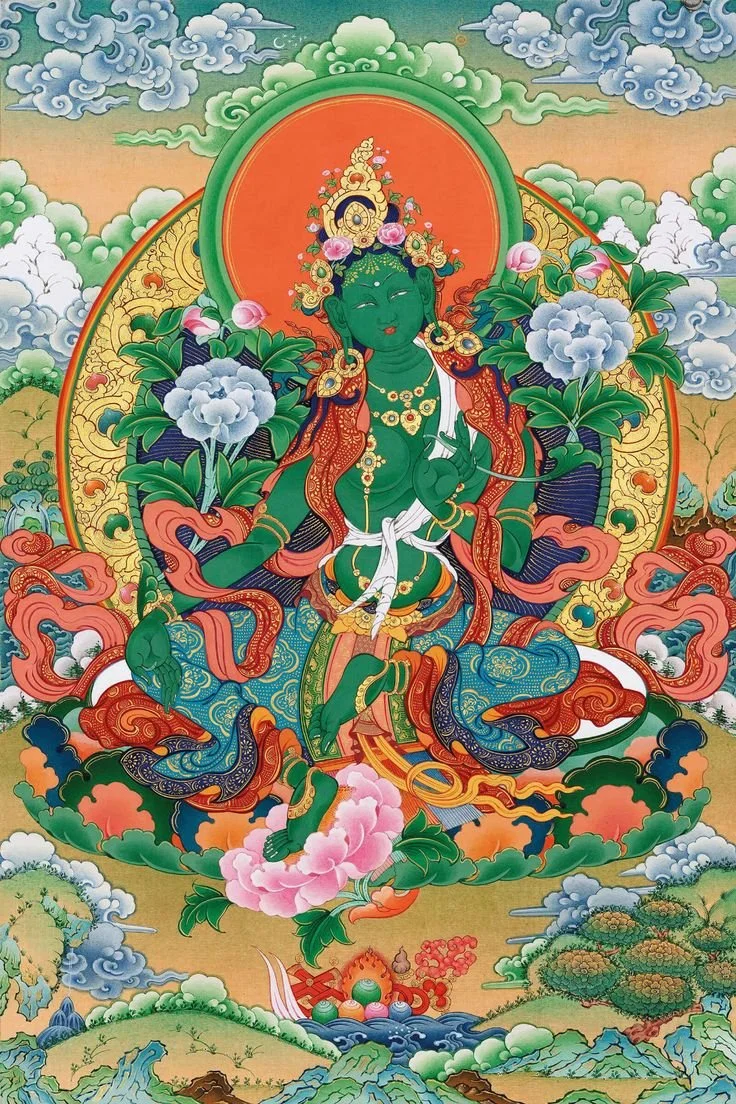
The Compassionate Goddess Who Guides Across All Fears

Without fully understanding why, an ancient wisdom within me somehow drew me very close to this goddess. At 17, when I was beginning to feel free and liberated from my parents, I decided to get my first tattoo on my back. An inner attraction to her image and the meaning behind it pulled me to do it in a rebellious way, without my parents or family knowing. That time also marked the beginning of my yoga journey. I deeply respect this goddess in all her aspects, and she has helped me immensely along this path.
Tara is considered a bodhisattva, “a being dedicated to awakening.” In honor of her guidance and my own path, I have named myself Lita Sattva. This deity holds deep significance for me and has become a meaningful presence in my life journey.
Origins and Meaning…
… among the most beloved figures in spiritual traditions across Asia is Tara, a radiant embodiment of compassion, protection, and swift action. Revered in both Buddhism and Hinduism, Tara is often called the “Mother of Liberation,” guiding devotees across the turbulent ocean of suffering toward peace and awakening. The name “Tara” comes from a Sanskrit root meaning “to cross,” “to ferry,” or even “star.” Much like a guiding light or a spiritual boatwoman, Tara helps beings cross from fear and ignorance to wisdom and enlightenment. In Buddhist traditions, she is considered a bodhisattva, one who chooses to remain engaged with the world to help others awaken. Some legends describe her as emerging from the tears of Avalokiteshvara, symbolizing compassion in action.
In Hindu traditions, Tara appears as one of the Mahavidyas, a group of powerful wisdom goddesses associated with transformation and transcendence.
Tara is considered a bodhisattva, a concept that represents one of the most profound and inspiring ideals in Buddhism, especially within the Mahayana tradition. The word comes from Sanskrit: bodhi, meaning “awakening” or “enlightenment,” and sattva, meaning “being.” Together, it can be understood as “a being dedicated to awakening.”
But this definition only scratches the surface.
At its heart, a bodhisattva is someone who chooses a path of deep compassion and responsibility. Rather than seeking enlightenment purely for personal liberation, a bodhisattva makes a powerful inner commitment: to awaken for the benefit of all beings. Even when they gain insight or spiritual realization, they do not turn away from the world. Instead, they remain engaged, guiding, supporting, and helping others move through suffering.
This intention is often expressed through what is known as the bodhisattva vow… a promise to assist all beings in reaching freedom from suffering, no matter how long it takes. It is an ideal rooted not in perfection, but in dedication.
One of the most well-known examples is Avalokiteshvara, who embodies infinite compassion and is said to hear the cries of the world. In many traditions, Tara is seen as an expression of that same compassionate energy… swift, responsive, and actively engaged in helping those in need.
The path of a bodhisattva is often described through qualities such as compassion, wisdom, patience, generosity, and courage. These are not abstract virtues, but lived practices, how one speaks, acts, and relates to others. A bodhisattva strives to see beyond the illusion of separation and recognizes the interconnectedness of all life.
Importantly, being a bodhisattva is not limited to monks, nuns, or spiritual figures. It can be understood as a way of being in the world. Each moment of kindness, each act of understanding, each choice to respond with awareness instead of reactivity, these are small but real expressions of the bodhisattva spirit.
In this sense, the bodhisattva is both an ideal and a mirror: a reminder that awakening is not only about personal peace, but about contributing to a more compassionate and conscious world.
The 21 Taras: Expressions of Compassion
In Tibetan Buddhism, the 21 Taras are described in a traditional praise text, each embodying a specific quality - protection, courage, healing, magnetism, and fierce transformation. Rather than separate deities, they are different expressions of the same compassionate essence.
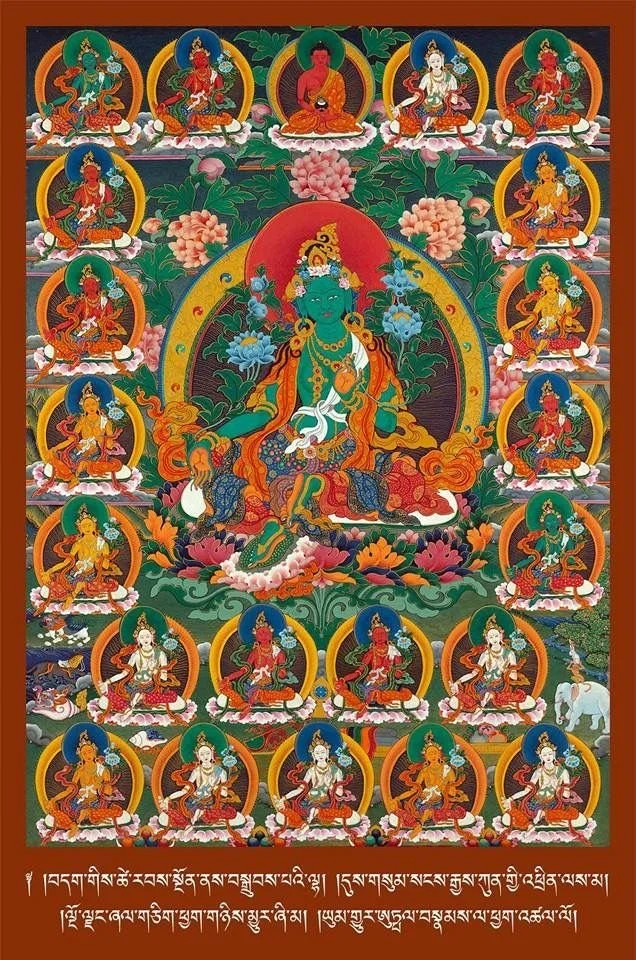
Key Forms That May Resonate
1. Green Tara - The Swift, Fearless Protector: She represents action, independence, and stepping into your own path. Associated with breaking free from fear and limitation, she is often linked to moments of transition and personal liberation. Her energy is bold, responsive, and protective.
2. White Tara - The Inner Guide and Healer: She embodies wisdom, healing, and deep inner awareness. Associated with longevity and spiritual maturity, her presence is gentle yet powerful - nurturing, watchful, and calm.
3. Red Tara - Kurukulla - The Magnetic, Heart-Centered Force: This form represents attraction, passion, and transformation through desire. She draws you toward what your soul truly seeks, with an energy that is intense, creative, and magnetic.
4. Golden (Yellow) Tara : She represents abundance, prosperity, and the natural flow of generosity. Her energy is not about attachment or material accumulation, but about openness - allowing life’s resources to circulate freely with trust and balance.
The remaining forms expand Tara’s qualities across all aspects of life:
Blue (Fierce) Tara – protection and cutting through illusion
Tara Who Destroys All Fears – protection from inner and outer dangers
Tara of Victorious Power – overcoming obstacles
Tara Who Subdues Negative Forces – calming conflict
Tara Who Grants Wishes – fulfilling aligned intentions
Tara Who Removes Suffering – emotional healing
Tara of Radiant Light – clarity and insight
Tara of Auspiciousness – harmony and good fortune
Tara Who Protects from Poison – healing toxicity
Tara of Wrathful Compassion – destroying ego illusions
Tara Who Dispels Nightmares – easing fear and anxiety
Tara of Joyful Energy – vitality and inspiration
Tara Who Guides Through Danger – protection in transitions
Tara of Inner Strength – resilience and courage
Tara Who Brings Harmony – emotional and relational balance
Tara of Spiritual Achievement – supporting awakening
Tara of Complete Liberation – ultimate freedom
How to Relate to the 21 Taras
It’s natural to wonder, “Which one is mine?” But the 21 Taras are not fixed identities, they are energies you move through. At different moments in life, different aspects become more present. What matters is not choosing one, but recognizing which quality is alive within you.
Tara’s imagery is rich with meaning. She is often depicted seated on a lotus flower, symbolizing purity arising from the mud of worldly experience. Her hand gestures (mudras) express protection, generosity, and reassurance.
A key detail in many depictions is her posture: one leg folded in meditation, the other extended, ready to step into the world. This perfectly reflects her nature as both deeply grounded in awareness and actively engaged in compassionate action.
Tara is known for her accessibility, she is often described as immediate and responsive, someone you can call upon in moments of fear or uncertainty.
Her mantra:
Om Tare Tuttare Ture Soha
… is widely chanted to invoke protection, remove obstacles, and reconnect with inner clarity. Even a few repetitions, done with intention, can create a sense of grounding and support.
Today, Tara continues to inspire spiritual seekers around the world. She is often seen as a symbol of feminine strength, intuitive wisdom, and empowered compassion. In a fast-moving and uncertain world, her message feels especially relevant: courage and compassion are not opposites - they are deeply interconnected.
Tara exists at the meeting point of myth and lived experience. Whether seen as a divine presence, an archetype, or a reflection of inner potential, she reminds us that support, clarity, and transformation are always available.
To call upon Tara is, in many ways, to call upon the most courageous and compassionate parts of yourself.
May all beings be free from fear.