WALKING DURGA’S PATH
It has been a long time since I’ve taken the space to write, to share reflections, and to bring a monthly theme into the practice. This used to be a ritual of mine, but with motherhood and the unexpected shifts of life, some rhythms were gently placed on pause.
Now, I feel called to return.
I am being deeply inspired and motivated to continue my yoga studies, and one of the reasons for bringing Durga’s philosophy into our practice this month comes from this renewed commitment. I have recently begun studying the Jivamukti method, a path that resonates profoundly with me. Inspired by its Focus of the Month, I feel invited to weave a similar thread into my own classes: a way to study, embody, and share these teachings with you in real time.
This is not just for me, it is something I believe we can all benefit from. A shared space of learning, reflection, and practice. A ritual we grow into together.
The classes will still be called Rocket Vinyasa Yoga, and yet, beyond any label, what matters most is the intention behind the practice. Rocket, at its core, is rooted in a sense of collective awareness, a practice that does not divide, but connects… that invites individuality while honoring community.
I feel that this is a safe and open space where I can share what truly resonates with me, what inspires me, and what continues to shape my path. For me, it is essential to honor yoga in its wholeness, not only as āsana, but as a living philosophy expressed through movement, breath, meditation, chanting, mythology, and study.
The name of the practice matters, but equally important is the voice and inner intention of the teacher. And this is one of Durga’s deepest teachings: true power does not arise from domination, but through integration and collaboration.
With this intention, I want to create a meaningful space for all of us…
to reflect, to experience, and to explore both on and off the mat.
This month, the live classes will focus on the energy of the warrior, not as aggression, but as presence, clarity, and courage. We will explore warrior-based practices, including Hanuman Dands, warrior āsanas, and strength-building sequences, where mental focus and physical embodiment come together. Through this, we will begin to experience not only individual strength, but also the wisdom of interconnection.
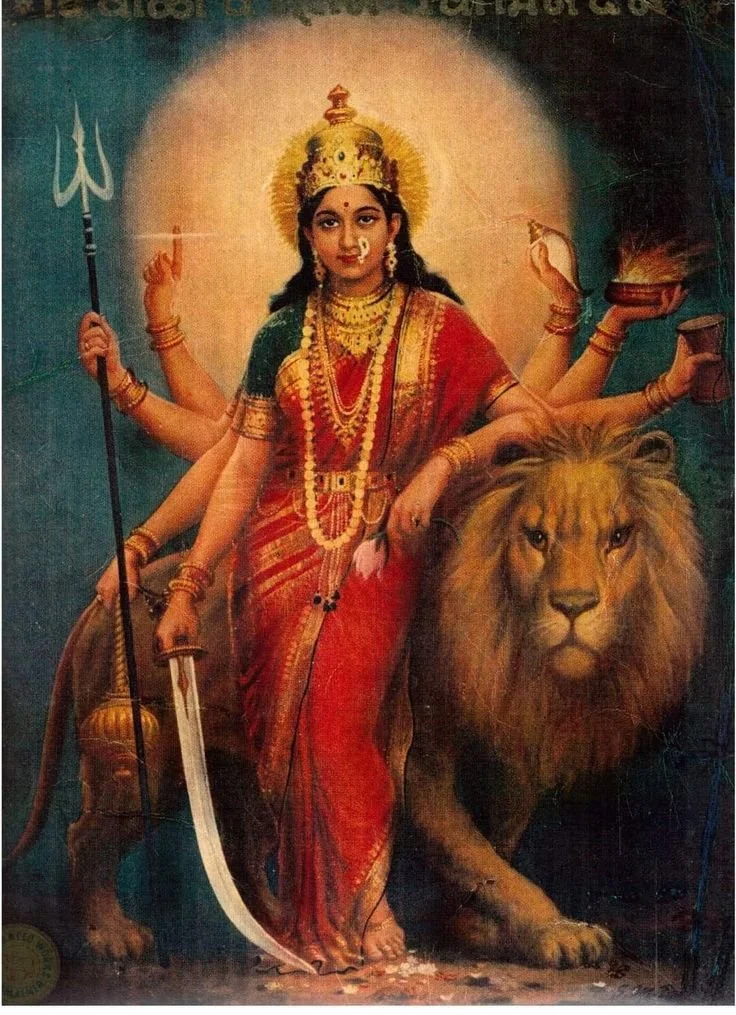
The Power of the Warrior
In the vast universe of Hindu mythology, Durga stands as one of the most complex and powerful embodiments of the divine feminine. She is at once a warrior and a mother, a destroyer and a nurturer, a force of fierce protection and gentle restoration. To understand Durga is to move beyond simplistic ideas of power and into a deeper recognition: that true strength is multidimensional, and transformative.
The warrior energy that Durga embodies is not rooted in aggression or domination. It is a conscious, purposeful force, one that arises when something essential must be protected, restored, or brought back into balance. Her battle against Mahiṣāsura is not simply a myth of good versus evil, but a symbolic teaching about the forces we encounter within and around us: ego, illusion, greed, and the misuse of power. Durga does not fight out of anger, she acts from clarity, alignment, and presence.
This is the essence of the warrior: not one who seeks conflict, but one who is willing to stand in truth. A warrior is someone who can meet difficulty without turning away, who can remain steady in the face of chaos, and who knows when to act and when to soften.
Mastery over the self: The true warrior practices self-control (over thoughts, emotions, and impulses). This aligns with the concept of inner discipline (tapas).
Clarity and right action (dharma): A yogic warrior acts according to dharma, their deeper purpose or ethical duty, even when it’s difficult.
Detachment from outcomes: One of the central teachings (especially in the Bhagavad Gita) is to act fully, but without attachment to results. The warrior does their duty without being ruled by success or failure.
Courage to face inner battles: Rather than conquering external enemies, the yogic warrior faces internal obstacles like ignorance (avidya), ego (asmita), and fear.
Steadiness and presence: In both meditation and life, the warrior cultivates a calm, steady mind… even in chaos.
At the same time, Durga never loses her connection to the heart. Even in her most fierce forms, she remains deeply rooted in care for life. This is what makes her power so unique, her capacity to hold both intensity and tenderness simultaneously. She protects not to dominate, but to preserve the conditions for life to flourish.
In our own lives, the power of the warrior may look different from what we imagine. It may appear in the courage to set boundaries, to speak truth, to take action where there is injustice, or to remain committed to a path of growth even when it is uncomfortable. It may also appear in quieter ways, in the discipline to show up for practice, in the patience to heal, or in the willingness to care deeply in a world that often encourages disconnection.
To embody Durga’s warrior energy is to understand that strength and compassion are not opposites, they are interdependent. True power lies not in overpowering, but in aligning with what is right, protecting what is sacred, and acting with both courage and wisdom.
This is the invitation of the warrior: to stand fully present, to act with intention, and to become a force that not only confronts darkness but also creates the conditions for light and growth.
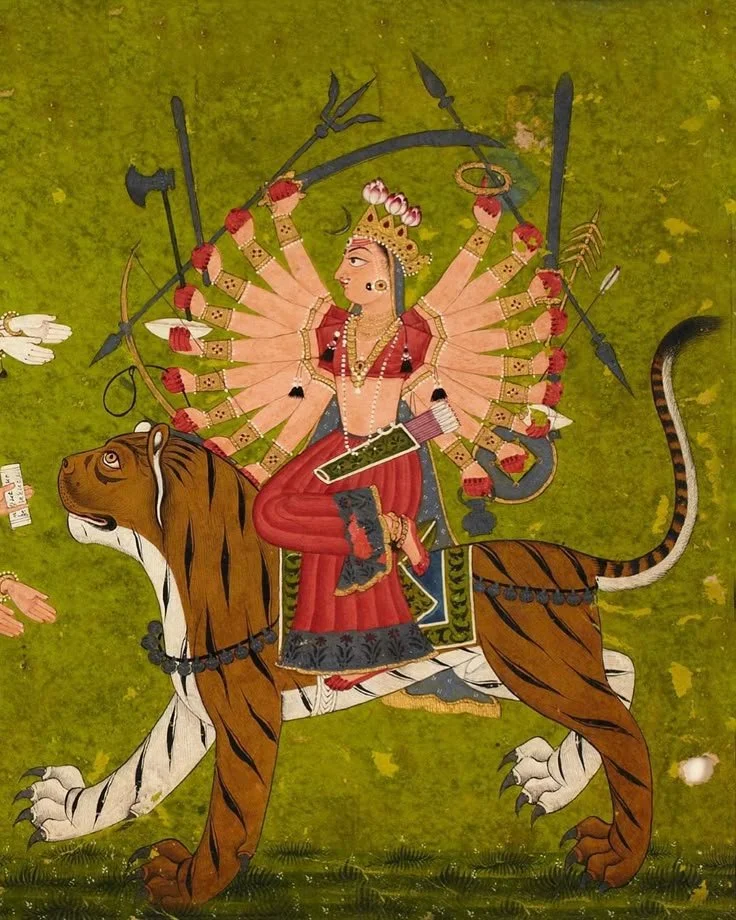
The Warrior Who Restores Balance
Durga’s battle with Mahiṣāsura is one of the most iconic myths in Hindu tradition. Riding her lion, clothed in red (the color of action) she confronts the demon who represents arrogance, unchecked ambition, and the abuse of power.
She fights to restore balance (dharma). Her strength is purposeful, precise, and guided by wisdom. What makes Durga unique is that she does not carry her own weapons alone, each weapon is gifted to her by the gods, symbolizing that her power is collective, composed of many forces unified into one.
Durga’s origin story reveals one of her most essential teachings: power is collective. When the demon Mahiṣāsura terrorized the worlds and no single god could defeat him, the gods combined their energies to create Durga. Each deity offered her a weapon, symbolizing their unique strength, courage, discernment, clarity, action.
She embodies the idea that no single force is sufficient on its own; rather, it is through the integration of many strengths that true power emerges. This message resonates deeply today, reminding us that collective action, whether in community, activism, or ecology… is the foundation of meaningful change.
These weapons are not merely instruments of destruction, they are embodied qualities, tools for both outer and inner transformation:
The Trident (Trishula) – from Shiva
The trident represents the power to pierce through illusion (maya) and transcend the three fundamental limitations: ego, attachment, and ignorance. It is also said to symbolize the triad of creation, preservation, and destruction. With this weapon, Durga cuts through what is false to reveal truth.The Discus (Chakra) – from Vishnu
The spinning discus represents cosmic order and righteous action (dharma). It moves with precision and cannot be stopped, symbolizing clarity in action and the ability to act without hesitation when aligned with truth.The Thunderbolt (Vajra) – from Indra
The vajra embodies unshakable determination, strength, and spiritual resolve. It represents the power of focused intention, the ability to remain steady and unwavering, even in the face of adversity.The Spear (Shakti) – from Agni
The spear symbolizes penetrating insight and transformative energy. Like fire, it purifies, burns away impurities, and creates space for renewal.The Sword (Khadga) – from Ganesha (in some traditions)
The sword represents discernment (viveka), the ability to distinguish truth from illusion, the essential from the non-essential. It is sharp, clear, and decisive.The Bow and Arrow – from Vayu
The bow represents potential energy, while the arrow symbolizes direction and action. Together, they teach focus, intention, and the alignment of thought and movement.The Mace (Gada)
The mace represents strength, both physical and mental, and is often referred to as the “ego-crusher.” It reminds us that true power requires humility and the ability to overcome pride.The Axe (Parashu) – from Vishvakarma
The axe symbolizes the power to cut attachments and to destroy what no longer serves. It carries both creative and destructive potential, reminding us that endings are part of transformation.The Lotus – from Brahma
The lotus represents purity, wisdom, and detachment. It grows from the mud yet remains untouched by it, symbolizing the ability to live in the world without being consumed by it.The Conch (Shankha)
The conch represents the primordial sound, OṀ, the vibration of creation itself. It is a call to awaken, to act, and to align with the rhythm of the universe.
Together, these weapons tell a deeper story: Durga does not rely on a single form of power. She embodies many qualities simultaneously, strength and softness, action and stillness, destruction and creation.
Her battle is not just external; it reflects the inner work we all face. Each weapon becomes a tool we can cultivate within ourselves: the clarity to see truth, the courage to act, the discipline to stay steady, and the wisdom to know when to let go.
Durga teaches us that sometimes protection requires action, but that action must always be rooted in clarity, integrity, and alignment with a greater balance.
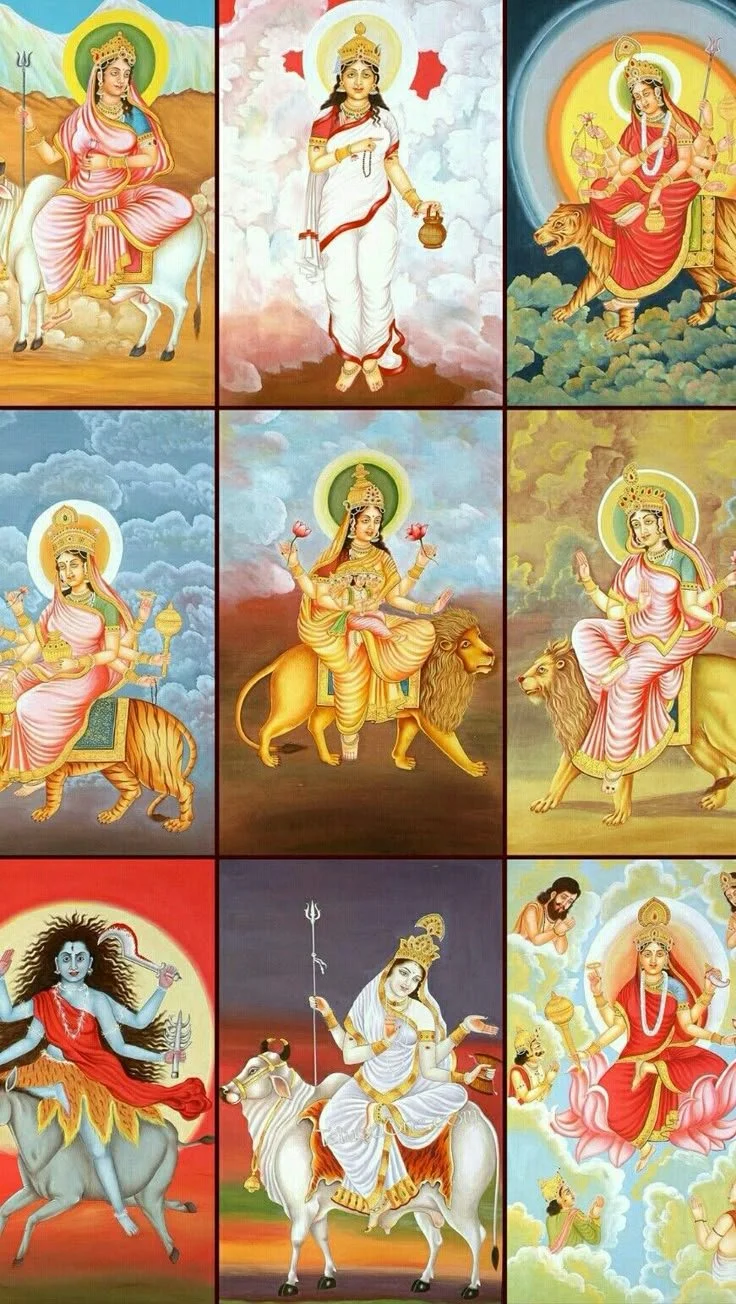
The Navadurga
The nine forms of the goddess, each representing a stage on the spiritual path, a journey of inner evolution that unfolds over time.
This journey moves from inspiration and grounding, to discipline and devotion, to courage, creativity, and expansion, to purification, discernment, and ultimately liberation.
These forms remind us that transformation is not instantaneous. Growth unfolds in stages, requiring different qualities at different times, patience, strength, rest, clarity, and perseverance.
The nine forms of Durga are traditionally worshipped during Navaratri, a sacred nine-night festival celebrated twice a year, Autumn and Spring. Each night (and day) is dedicated to one form of the goddess, honoring a specific stage of the spiritual journey.
It mirrors the inner path of transformation, guiding the practitioner from grounding and intention, through effort and challenge, into clarity, and finally toward integration and liberation.
Navaratri is not only a celebration, it is a practice of alignment with natural cycles. Just as the seasons shift and the earth renews itself, this period invites us to consciously move through phases of growth, release, and renewal. Here are the nine forms of Durga very synthesized.
Day 1 - Śailaputrī (Grounding): The journey begins with stability and connection to the earth. We root ourselves, setting intentions.
Day 2 - Brahmacāriṇī (Discipline): Devotion and inner focus are cultivated. This is the stage of commitment and steady effort.
Day 3 - Candraghaṇṭā (Courage): We begin to face challenges with bravery, awakening inner strength.
Day 4 - Kuṣmāṇḍā (Creation): Energy expands. Creativity, vitality, and new possibilities emerge.
Day 5 - Skandamātā (Nurturing): We care for what is growing. Compassion and support become essential.
Day 6 - Kātyāyanī (Action): The warrior awakens fully. We act with strength and clarity to overcome obstacles.
Day 7 - Kālarātri (Transformation): We enter the unknown, confronting fear and releasing what no longer serves.
Day 8 - Mahāgaurī (Purification): After the darkness, clarity and peace arise. This is renewal and inner light.
Day 9 - Siddhidātrī (Integration): The journey is complete in wholeness, wisdom, and a sense of deep alignment.
The structure of Navaratri reflects a profound truth, transformation is cyclical and intentional.
We are not meant to rush growth or skip stages. Each phase, whether it feels expansive or challenging, has its role in shaping who we become. Durga, through the Navadurga, becomes more than a mythological figure. She is a mirror of our own evolution, a reminder that we are constantly moving through cycles of beginning, effort, challenge, release, and renewal.
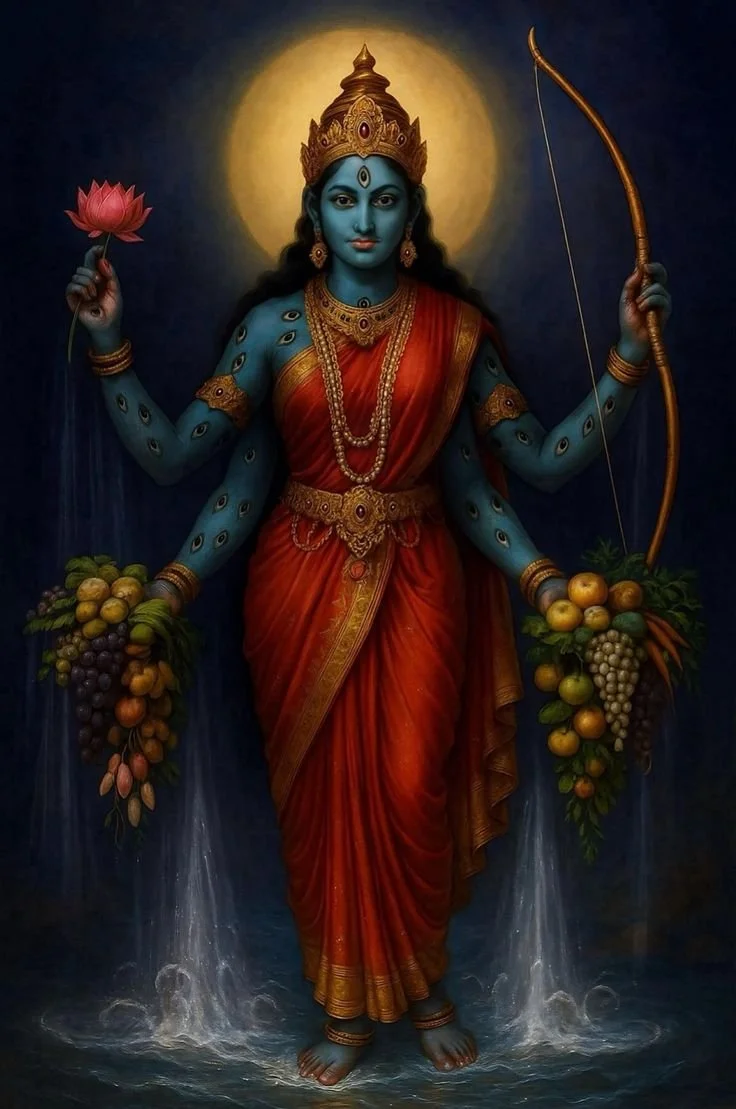
The Śatākṣī
Beyond her warrior form, Durga also appears as Śatākṣī, the “hundred-eyed” goddess, a form that reveals the quiet, life-giving power of compassion.
According to the Devi Bhagavata Purana, Śatākṣī manifests during a time of great suffering, when the earth is affected by drought and famine. The rivers have dried, vegetation has disappeared, and life is on the brink of collapse. Seeing the suffering of all beings, the goddess begins to weep. From her many eyes, tears fall endlessly, so abundantly that they fill the rivers, lakes, and oceans once more. With the return of water, the earth awakens: plants grow, food returns, and life begins again.
In some tellings, she is also known as Śākambharī, “the bearer of vegetation,” nourishing the world directly through plants and herbs. Together, these forms express a profound truth: the goddess does not only protect life…she sustains it from within.
the Hundred Eyes…
Śatākṣī’s many eyes are deeply symbolic. They represent awareness, presence, and the ability to truly see. She sees all beings, all suffering, all interconnection. Nothing is outside her field of care.
To “have a hundred eyes” is to live with expanded perception, to notice what is often ignored,
to remain sensitive rather than indifferent, to witness the world without turning away.
Her tears are the natural response of this awareness. They are not a sign of weakness, but of deep connection. In her, feeling and action are not separate, her compassion becomes water, and her water becomes life.
Śatākṣī reveals a dimension of power that is often overlooked… compassion as an active, regenerative force.
Her tears do not merely express emotion, they transform reality. They restore ecosystems, reestablish balance, and allow life to flourish again. This challenges the common perception that strength must be hard, detached, or dominant. Instead, Durga shows us that care, empathy, and nourishment are among the most powerful forces that exist.
In this way, Śatākṣī becomes a bridge between spirituality and ecology. Her story mirrors the natural world, water sustains life, and without it, nothing can survive. Her tears remind us that what we feel, and how we respond, has the power to shape the world around us.
This can be an eye-opener for all of us. We choose whether to see what is happening around us, and we have the power to act, or to close our eyes. Compassion, empathy, and care make us better human beings. And when we stop seeking renewal, we often find that the renewal we receive goes far beyond material things.
Śatākṣī and Śākambharī…
…are traditionally honored in certain regional festivals and rituals dedicated to the nourishing forms of the goddess, often connected to agriculture, fertility, and the cycles of the earth. These celebrations recognize the divine as the source of food, water, and life itself.
Her energy also resonates strongly with seasonal transitions, particularly the movement into spring, when the earth reawakens, waters begin to flow, and life returns after dormancy. In this sense, Śatākṣī is not bound to a single ritual moment, she is present whenever life is restored.
A Message for Our Time
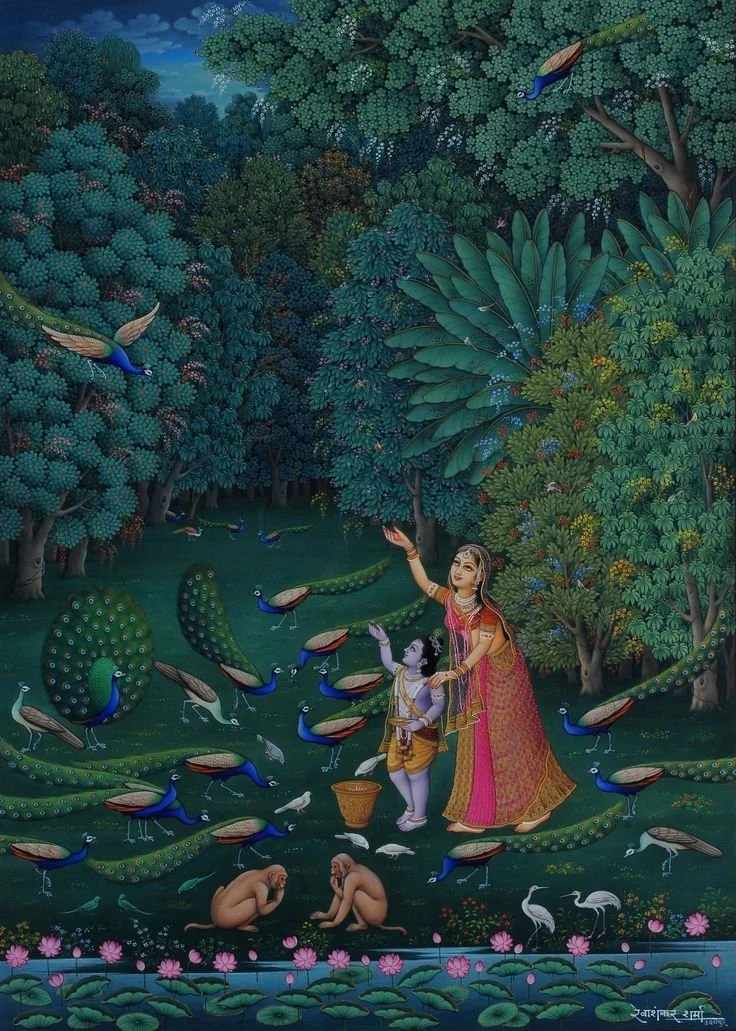
In an age marked by ecological crisis, climate change, and increasing disconnection, Śatākṣī’s story feels especially urgent. She invites us to reconsider our relationship with the earth, not as something to control or exploit, but as something we are deeply part of.
Her teaching is simple, yet profound… what we nourish, grows.
To embody her energy is to ask:
Where can I bring care instead of indifference?
How can I respond to suffering with action?
What does it mean to truly sustain life…in my body, my community, and the environment?
Śatākṣī reminds us that nourishment, care, and empathy are not passive qualities; they are essential forces of survival and renewal. She is the living embodiment of the ecosystem itself, simultaneously fierce and nurturing, destructive and regenerative, individual and collective.
Durga redefines what it means to be powerful. She is not power as domination, but power as balance, integration, and life-giving force. She is the fire that destroys illusion and the water that restores the earth. She is the warrior who protects and the mother who nourishes.
In a world that often equates strength with control, Durga offers a different vision.
That true power lies in the ability to protect, to nurture, to adapt, and to act with both courage and compassion.
To follow her path is to recognize that the work of transformation… personal, collective, and ecological, is ongoing. It requires us to show up again and again, in many forms, with many tools, guided by a shared intention… to restore balance, to cultivate life, and to allow the world to flourish.